
International reporting: explain the event and the frame around it
Reporting across borders requires more than translating a headline. Dates, institutions, language and local perspectives change what a fact means.
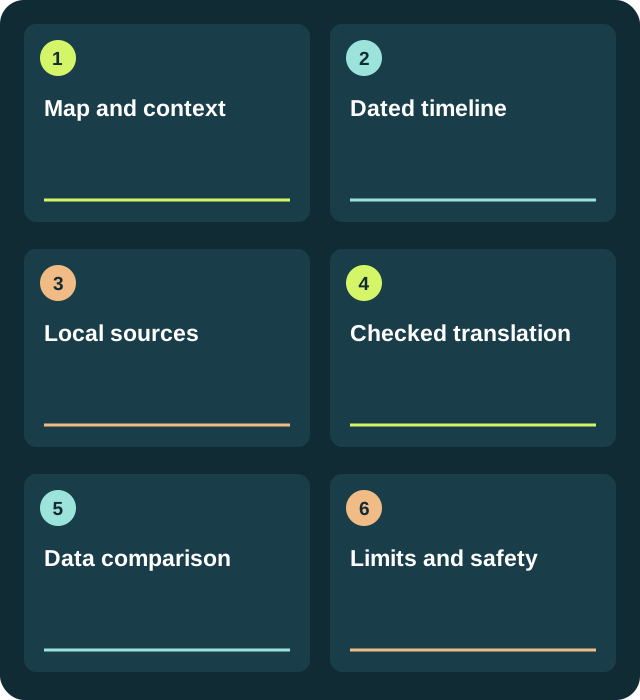
Build a context file
Start with a map, a dated timeline and a glossary of institutions. Describe what an institution does rather than assuming its name is familiar. Keep local and international sources in separate columns so one wire report does not become three supposedly independent confirmations. Record the original language and the person responsible for a translation.
Test the interpretation
Compare the claim with an original document and reporting from the affected region. A quoted figure may refer to a different calendar year, currency or geographic boundary. Explain these differences before drawing a comparison. If a translation changes a politically significant term, show the ambiguity. Distinguish a government’s account from an independently verified event.
Plan proportionate publication
Choose a focused question that can be answered with available evidence. Include relevant context without turning a country into a single narrative. Do not disclose a source’s location or identity merely to make the story feel authoritative. For hazardous assignments, obtain professional safety and legal support; a classroom exercise does not prepare someone for a conflict deployment.
Practice pathway
- Map and contextRecord the decision and keep a version you can review.
- Dated timelineRecord the decision and keep a version you can review.
- Local sourcesRecord the decision and keep a version you can review.
- Checked translationRecord the decision and keep a version you can review.
- Data comparisonRecord the decision and keep a version you can review.
- Limits and safetyRecord the decision and keep a version you can review.
A piece with clear limits
Fictional comparison: two reports show growth of 4% and 6%. Check period, currency, inflation treatment and territory before comparing them. Explain incompatible definitions. Keep the original term when a translation could materially change its interpretation.
Try it
Compare two public reports about the same cross-border event. Make a table of date, place, original source, translation and unanswered questions. Write a 300-word explainer with explicit attribution.
Project deliverable
A reviewed piece, its source sheet and a note explaining what changed.
Download a working template
A pathway, worked example and six checks in an editable file. No account.
Download TXT ↓Review before publishing
Avoid live location disclosures and unsupported generalisations about populations. Resolve translation uncertainty before using a quotation.
Frequently asked questions
Can I enroll through this page?
The 2024–25 catalog informs today’s self-directed guides. No enrollment or accredited qualifications are offered.
What do I need to practise?
Start with this guide’s exercise and template. Use a document for sources and, for audio or video, a device that can record a test you can review. Choose material you have permission to use.
How do I review the result?
Compare two public reports about the same cross-border event. Make a table of date, place, original source, translation and unanswered questions. Write a 300-word explainer with explicit attribution.
Sources and provenance
The example and pathway are new editorial work; historical sources document the former topic, not a current offer.